Panthenol: What It Actually Does at a Cellular Level


Ingredients

Panthenol: Why It’s in Everything — and What It Does at a Cellular Level

70 years of clinical data. Converts to a CoA cofactor. Rebuilds the barrier from the inside. The science is deeper than “it’s soothing.”

B5 5% PROVITAMIN 70 YEARS OF DATA

1%
Minimum concentration for meaningful TEWL reduction
5%
Clinical-grade level used in medical healing formulas
14 days
Near-baseline TEWL recovery in irritant-damaged skin at 5%
2 hrs
Immediate TEWL reduction measurable after application

The Conversion That Makes It Work

Panthenol isn’t just a moisturizer that sits on top. It converts inside your skin into a cofactor that feeds the machinery that builds and maintains the barrier.

Panthenol (applied)
Pantothenic Acid (B5)
Coenzyme A
Fatty Acid Synthesis → Barrier Repair

The Concentration That Matters

Most clinical trials use 1–5% dexpanthenol. 1% is the threshold for meaningful TEWL reduction; 5% is standard in barrier-repair ointments and the concentration behind the strongest recovery data.

0.5%

Some hydration · Minimal barrier effect
1%

TEWL reduction threshold ✓
5%

Clinical grade · Near-baseline TEWL in damaged skin at 14 days
Panthenol doesn’t just sit on the surface and moisturize. It converts to a CoA cofactor and directly feeds the fatty acid synthesis that rebuilds the barrier.

Compatibility: Everything

Stable pH 4.0–7.5. Pairs with ceramides, niacinamide, hyaluronic acid, retinol (buffers irritation), vitamin C, centella. No photosensitivity. AM and PM. Especially valuable after cleansing and after actives that challenge the skin. Safe during pregnancy.

The Allergy Nuance

Historical allergy rate: 0.2–0.7%. Recent data: rising to ~1.2%. Many cases go undetected because panthenol is in products labeled “hypoallergenic.” If you keep reacting to “gentle” products, panthenol is worth patch-testing for. It’s rare — but it’s not zero.

Final Take

Panthenol is in everything because it genuinely works — and the evidence is unusually deep. At 1%+ it meaningfully reduces TEWL. At 5%, in irritant-damaged skin, it brings TEWL back to near-baseline within two weeks. The cellular mechanisms are specific: CoA synthesis, keratinocyte proliferation, lipid lamellae organization, wound-healing gene upregulation. Not glamorous, but one of the most reliably effective actives in skincare.
PanthenolVitamin B5Barrier RepairK-BeautyWound Healing


Similar Posts

  • Vitamin C vs. Derivatives

    Vitamin C: The Stability vs. Results Trade-Off Ingredients Vitamin C in Skincare: The Stability vs. Results Trade-Off The form with the strongest evidence is the hardest to keep stable. Here’s what actually works — and what’s just surviving the bottle. By The K Lab · Skincare Ingredient Guide 20% Max absorption ceiling — above this,…

  • Ceramides

    Ceramides: Repair Your Barrier or Just Sit on Top? Ingredients Ceramides: Do They Repair Your Barrier — or Just Sit on Top? Not every ceramide product actually integrates into your barrier. The lipid trio ratio and the delivery system matter more than the ingredient name. By The K Lab · Skincare Ingredient Guide BRICKS =…

  • Niacinamide

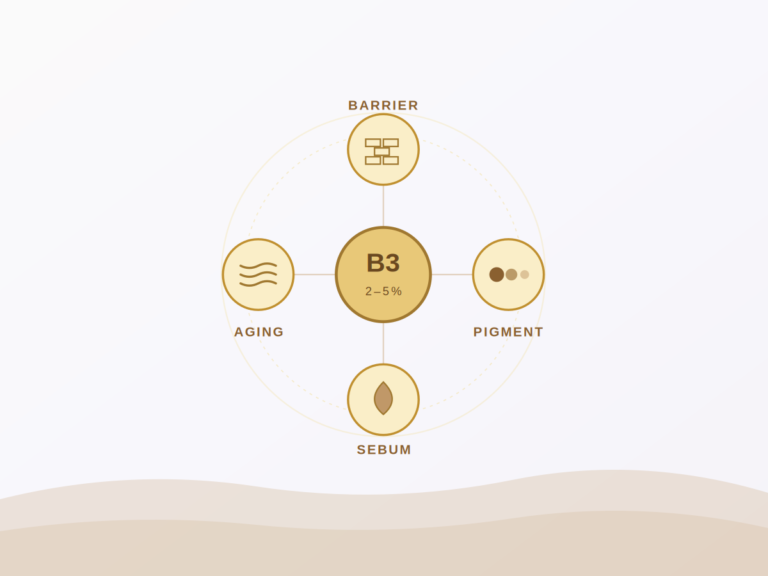
    Niacinamide: Is 10% Too Much? Ingredients Niacinamide: Is 10% Too Much? More niacinamide doesn’t mean more results. The clinical data makes that surprisingly clear. By The K Lab · Skincare Ingredient Guide BARRIER PIGMENT SEBUM AGING B3 2–5% 2–5% Best-supported concentration range across clinical trials 4 wk Barrier & tone improvements visible in most studies…

  • alcohol

    Alcohol in Skincare: Drying vs Functional Ingredients Alcohol in Skincare: Two Categories That Do Opposite Things Cetyl alcohol and denatured alcohol share the word “alcohol” the same way a ladybug and a bedbug share the word “bug.” By The K Lab · Skincare Ingredient Guide DENAT strips CETYL softens vs SAME WORD ≠ SAME THING…

  • Collagen

    Collagen: Why It Doesn’t Absorb Ingredients Collagen in Skincare: Why It Doesn’t Absorb — and Why Brands Still Use It Collagen is 75–80% of your dermis. It’s also 600× too large to get through your skin. So why is it in every anti-aging product? By The K Lab · Skincare Ingredient Guide 300 kDa STRATUM…

  • Hyaluronic Acid

    Hyaluronic Acid: Why It Can Dry Your Skin Out Ingredients Why Hyaluronic Acid Can Actually Dry Your Skin Out It’s the most popular hydrating ingredient in skincare. What it does depends entirely on how and where you use it. By The K Lab · Skincare Ingredient Guide H₂O SKIN SURFACE <40% Humidity below this level…

Leave a Reply

Your email address will not be published. Required fields are marked *